You’re losing more hair than you used to. The pillow has telltale strands. The shower drain tells the story before you do. And somewhere between trying every oil, shampoo, and supplement — you’ve heard about PRP.
But does it actually work? Or is it just another expensive trend?
If you’ve been searching for a credible, science-backed answer, you’re in the right place. PRP treatment in Indore has grown significantly in popularity over the last few years, and for good reason — the results, when done correctly by a qualified expert, are real and often transformative.
Let’s break it all down — no fluff, no false promises.
What Is PRP Treatment for Hair?
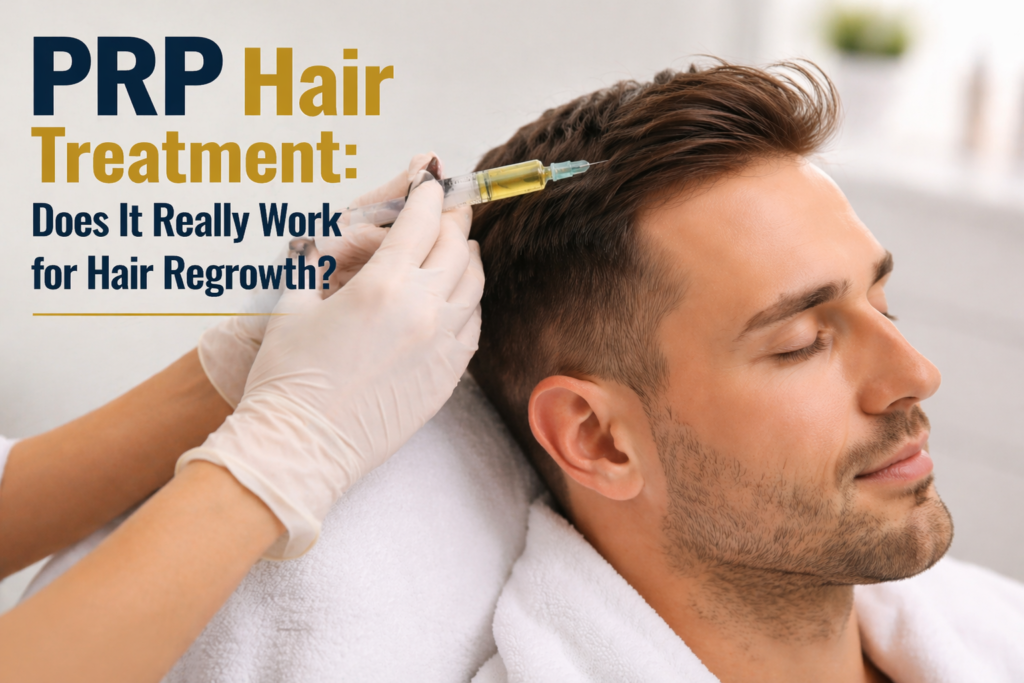
PRP stands for Platelet-Rich Plasma. It is a concentration of your own blood’s growth factors, extracted and injected directly into your scalp to stimulate dormant or weakening hair follicles.
Here’s the simple science behind it:
- Your blood contains platelets — tiny cells loaded with growth factors
- These growth factors trigger cell regeneration and tissue repair
- When injected into the scalp, they wake up sleeping follicles, improve blood supply, and strengthen hair roots from within
The treatment uses your own blood, which means there’s virtually no risk of allergic reaction or rejection. It’s 100% biocompatible and natural.
How Is PRP Treatment Performed? (Step-by-Step)
The procedure is straightforward and typically takes 45–60 minutes in a clinical setting.
Step 1 — Blood Draw A small amount of blood (around 20–30 ml) is drawn from your arm — similar to a routine blood test.
Step 2 — Centrifugation The blood is placed in a centrifuge machine, which spins at high speed to separate the platelet-rich plasma from red blood cells.
Step 3 — Activation The concentrated PRP is activated (sometimes with calcium chloride) to release the growth factors.
Step 4 — Scalp Injection Using fine micro-needles, the PRP is injected into targeted areas of the scalp where hair is thinning or receding.
Step 5 — Recovery There is no downtime. Most patients resume their routine the same day.
Does PRP Actually Work? What Does the Research Say?
Yes — and the evidence is growing.
Multiple peer-reviewed studies have shown that PRP therapy significantly:
- Increases hair density (number of hairs per cm²)
- Reduces hair fall within the first few sessions
- Improves hair shaft thickness and overall scalp health
- Prolongs the anagen (growth) phase of the hair cycle
A study published in the Journal of Cutaneous and Aesthetic Surgery found that patients who underwent PRP therapy showed a statistically significant improvement in hair count and thickness after three sessions.
However — and this is important — PRP works best for specific types of hair loss, particularly:
- Androgenetic alopecia (male and female pattern baldness)
- Alopecia areata (patchy hair loss)
- Hair thinning due to stress or nutritional deficiency
- Post-partum hair loss in women
- Early-stage hair loss in both men and women
It is not a miracle cure for advanced baldness where follicles are completely dead. The earlier you start, the better the outcome.
Who Is the Right Candidate for PRP Hair Treatment?
| Suitable Candidates | Not Ideal Candidates |
| Early to moderate hair thinning | Severe/complete baldness (dead follicles) |
| Men & women with pattern hair loss | Active scalp infections |
| Post-partum hair loss | Blood clotting disorders |
| Hair loss due to stress or nutrition | Those on blood thinners |
| Patients post hair transplant (maintenance) | Active cancer or chemotherapy patients |
| Alopecia areata cases | Chronic liver or thyroid disorders |
If you’re unsure which category you fall into, a proper scalp evaluation by a specialist is the first step.
What Results Can You Realistically Expect?
Let’s be honest about the timeline.
- After Session 1–2: Reduced hair fall, improved scalp condition
- After Session 3–4: Visible reduction in shedding, early signs of new growth
- After 3–6 Months: Noticeable increase in hair density, thicker strands, improved coverage
- After 6–12 Months: Fuller results with maintenance sessions
Results are gradual and cumulative. PRP is not a one-shot fix. Most experts recommend:
- 3–6 initial sessions, spaced 3–4 weeks apart
- Followed by maintenance sessions every 4–6 months
Consistency is everything. Patients who complete the full recommended cycle see the most dramatic improvements.
PRP vs. Other Hair Loss Treatments: A Quick Comparison
| Treatment | Invasive? | Downtime | Natural? | Best For |
| PRP Therapy | Minimally | None | Yes (own blood) | Early-moderate hair loss |
| Minoxidil (Topical) | No | None | No | Ongoing maintenance only |
| Finasteride (Oral) | No | None | No | Male pattern baldness |
| Hair Transplant | Yes | 7–14 days | Partial | Advanced hair loss |
| GFC Therapy | Minimally | None | Yes | Similar to PRP, often combined |
| Mesotherapy | Minimally | None | Partial | Diffuse hair thinning |
PRP stands out because it works with your body’s own biology, has no systemic side effects, and can be combined with almost any other treatment for enhanced results.
PRP Treatment Cost in Indore
One of the most searched questions — and understandably so.
The cost of PRP treatment in Indore typically ranges between:
- ₹3,000 – ₹8,000 per session depending on the clinic, doctor’s expertise, and technique used
- A typical course of 6 sessions may cost between ₹18,000 – ₹40,000
Factors that influence the price:
- Severity of hair loss (number of sessions needed)
- Quality of equipment (centrifuge speed, PRP concentration method)
- Doctor’s expertise and clinic reputation
- Combination treatments (PRP + GFC or PRP + Mesotherapy)
💡 Tip: Always prioritize quality over cost when it comes to medical procedures. A poorly done PRP session can waste both money and time.
Why Choose Dr. Jaismeen Kaur Arora at Alpha Skin Clinic, Indore?
When it comes to PRP therapy, the skill of the doctor and the quality of the protocol matter more than most people realize.
Dr. Jaismeen Kaur Arora at Alpha Skin Clinic, Indore brings a highly personalized, evidence-based approach to hair loss treatment. Here’s what sets the practice apart:
- ✅ Thorough scalp analysis before recommending PRP
- ✅ Customized PRP concentration based on the degree of hair loss
- ✅ Sterile, clinical-grade equipment for safe and precise treatment
- ✅ Combination protocols — PRP paired with GFC or other therapies where needed
- ✅ Transparent counseling — no overselling, no unrealistic promises
- ✅ Follow-up care and progress tracking throughout the treatment cycle
At Alpha Skin Clinic, the goal is not just hair regrowth — it’s restoring your confidence with results you can see and feel.
Side Effects: Are There Any Risks?
PRP is one of the safest hair treatments available, but like any medical procedure, minor side effects can occur:
- Mild redness or swelling at injection sites (resolves within a few hours)
- Tenderness on the scalp for 1–2 days
- Temporary headache in rare cases
- Minor bruising at the blood draw site
Serious complications are extremely rare when performed by a qualified professional in a sterile environment.
Post-treatment care tips:
- Avoid washing hair for 24 hours
- Skip intense workouts for 48 hours
- Avoid direct sun exposure on the scalp for a day
- No alcohol or anti-inflammatory medications for 3–5 days before sessions
PRP for Hair Loss in Men vs. Women
Both men and women can benefit significantly from PRP, though the underlying causes differ.
For Men: PRP is highly effective against androgenetic alopecia (receding hairline, crown thinning). When started in early stages, it can significantly slow progression and improve density.
For Women: PRP is particularly useful for diffuse hair thinning, post-partum hair loss, and hormonal hair loss. Many women see dramatic improvement in overall hair volume and quality.
A reputed dermatologist in Indore will assess your hormonal profile, scalp condition, and hair loss pattern before recommending PRP as a standalone or combined approach — ensuring you’re not wasting a single session.
Final Verdict: Is PRP Worth It for Hair Regrowth?
Yes — if you’re the right candidate and you go to the right doctor.
PRP is not a magic wand, and it’s not for everyone. But for people experiencing early-to-moderate hair thinning, pattern hair loss, or post-partum shedding, it is one of the most scientifically validated, non-surgical, natural solutions available today.
The key is starting early, staying consistent, and choosing a clinic where the science is taken seriously — not just the sales pitch.
If you’ve been putting off addressing your hair loss, there’s no better time than now. The longer you wait, the more follicles you lose — and the harder regrowth becomes.
📞 Ready to find out if PRP is right for you?
Book a consultation with Dr. Jaismeen Kaur Arora at Alpha Skin Clinic, Indore and get a personalized scalp assessment. Take the first step toward thicker, healthier hair — backed by science, driven by care.
Frequently Asked Questions
1. How many PRP sessions are needed for visible hair regrowth?
Most patients require 3 to 6 initial sessions, spaced 3–4 weeks apart. Visible improvements in hair thickness and reduced shedding are usually noticed after the 3rd session. A maintenance plan is recommended every 4–6 months for long-term results.
2. Is PRP treatment for hair painful?
PRP is generally well-tolerated. A topical numbing cream is applied before the procedure to minimize discomfort. Most patients describe it as a mild pricking sensation. Any soreness post-treatment typically resolves within 24–48 hours.
3. Can PRP regrow completely bald areas?
PRP works best where hair follicles are still alive but dormant or weakened. If an area has been bald for many years and follicles are completely inactive, PRP alone may not be sufficient. In such cases, a hair transplant followed by PRP maintenance may be recommended.
4. Can PRP be combined with other hair loss treatments?
Yes — and it often should be. PRP works excellently alongside:
- GFC (Growth Factor Concentrate) therapy
- Topical minoxidil or oral medications
- Mesotherapy
- Post hair transplant recovery Combining treatments often delivers faster and more sustained results.
5. How long do PRP hair treatment results last?
Initial results can last 12–18 months with proper maintenance. To sustain and build upon results, periodic touch-up sessions every 4–6 months are recommended. Lifestyle factors like diet, stress, and sleep also play a role in how long results last.
Disclaimer: Results may vary from person to person. PRP treatment should always be performed by a qualified medical professional after a thorough evaluation.